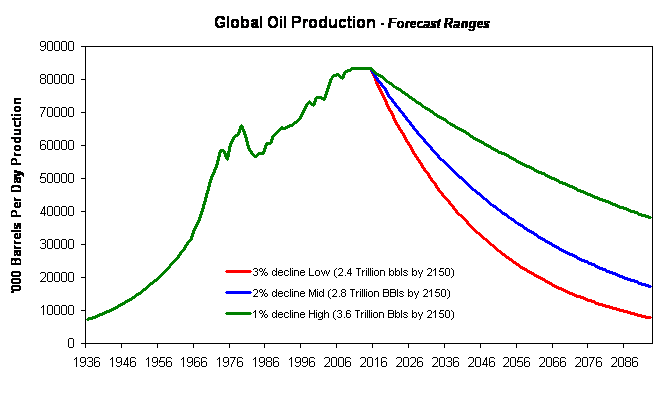
Lately, it seems like every time I turn the TV to news, finance or political programming, you hear consumers and politicians whining about the recent run-up in energy (particularly gasoline) prices. Although this complaining seems to be partially justified, few have answers to the continuous rise in demand and market assessed risk that remain the force behind rising fuel costs. In a capitalist economy, you have to accept the fact that markets set the price. Higher demand and risk mean higher fuel prices. If illegal price gauging activity is present in the marketplace, then by all means Congress and the justice system need to take action. However, in the previous 30 investigations led by the FTC, there has been no conclusion of wrongdoing.
Instead of sitting on your hands, upset about the higher cost of your summer vacation, hedge against fuel price inflation by investing in energy companies. As a sector, energy has performed well this year, especially oil exploration & drilling companies and refiners. These stocks are only beginning their upward summer trends. Baring a significant political or economic change in the industry, energy stocks should continue to increase in price, running up another 50% or more in some cases. Profiting from investments during inflation in energy prices helps to hedge your earnings and protect your wealth and purchasing power. Here are some ideas for investors:
If you are conservative in your stock selections, go with a typical big name driller or refiner. Some names to look at include Valero Energy -VLO- (still extremely undervalued using valuation measures), Marathon Oil -MRO-, Transocean -RIG-, or Exxon Mobil -XOM-.
For investors desiring higher earning potential, I recommend some energy plays abroad. Recently, international oil and gas companies have experienced significant stock price advances. Nevertheless, many of these companies remain undervalued when taking into account their projected earnings and revenue growth rates. Some companies to consider include Buffett-owned Chinese giant PetroChina -PTR- (AKA China National Petroleum Corporation, a stock I will discuss in my China sectorsnap later this week), Argentine emerger Petrobras Energia Participaciones S.A. -PZE-, and the Brazilian integrated Petroleo Brasileiro -PBR-.
Friday, May 25, 2007
As Energy Prices Rise, Fight Back With Investments


Monday, May 14, 2007
(Chile)ng Economic Trials
In a recent Wall Street Journal column, a reporter chronicled the upcoming problems the Chilean economy faces. Like several other developing nations, Chile's economy seems to have become over-reliant on a single industry. In this specific case, Chile's recent economic boom has been fueled largely by mining commodities, especially considering how copper has tripled in the past 5 years or so.
However, Chile is dissimilar in the methods it has taken to combat the volatility derived from commodity markets by using investment techniques on a percentage of revenue generated from taxes on the economy. With tax revenues higher during years of commodity price increases, Chile has been able to develop a system that invests a percentage of taxes during this period into foreign investments such as government bonds. Although it would generally be wiser of them to place this money in equities, I applaud the finance and economics ministries for even coming up with such an idea that generates guaranteed return on money they don't need to spend.
By hedging against these fluctuations in Chile's economy, stability and long-term upward growth can more easily be secured. Many of the dividends and repayment of these funds will be invested into innovation so that the country becomes competitive in other sectors such as Technology, Financial Services and Consumer Products. All too often, developing countries focus on short-term profits, economic growth and end up spending instead of accruing or building their wealth. You will be hard pressed to find any country that has a better long-term economic strategy and focus on innovation and techonological improvement then Chile.
As with any government, the diffulty to balance the budget always poses a threat and concern among politicians and citizens. Chile's comprehension of the peaks and valleys associated with commodity dependence help create barriers against recession or stagflation. There are always issues and programs that need financial support, but tighter spending leads to a more balanced budget and higher levels of fiscal responsibility. Maybe US Politicians can learn something from our Chilean allies.
Note: GDP for Chile rises significantly after 2002.

Sunday, May 13, 2007
How common investors can get in on Private Equity
For yet another year, Private Equity buyouts are expected to set a new record on Wall Street. Although the "rich get richer" theory applies, investors of all levels and experience have seen the benefits of leveraged buyouts. Rumors and announcements of LBOs stemming from Private Equity capital has driven stock prices dramatically higher, making these firms pay more for each acquisition or considered target. Although investors have little control over the situation and some may not want to lose ownership of the company they are part of, these Private Equity deals provide payouts of premiums that more then make up for these feelings.
Private Equity has remained an elitist group over time, with high barriers of entry. Until now. Presently, PE firms either trade sections of their firm publicly or have planned IPOs set to unveil before the end of this fiscal year. If you are looking for an immediate venture into ownership of a PE firm, you can try Fortress Investment Group (FIG), Apollo Group or KKR, the noteworthy firm that recently announced a bid for TXU. Investors with patience may want to wait for IPOs expected from the two most powerful and well-known firms in the PE world, Carlyle Group and Blackstone Group.
To some, it may seem confusing as to the reasoning behind Private Equity firms going public, especially because of their namesake. Thinking critically about how these firms derived their name, they still possess the ability to keep restructure and overhaul acquisitions in private. Disclosures in financial statements are a specific concern to some analysts, but the numbers will never fully display how the firms turnaround or fail with individual acqusitions. In addition, the acquisitions acquired by these financial barrons are likely to benefit because they are allowed to operate like a separate entity without the pressure of growing an artificial number such as a stock price.
Buyer beware though, as this article explains, PE firms stock growth after three years of their IPO is only 39% compared with normal growth of 45% for other companies. Also, as Adam Lashinsky writes, these PE firms are forced to cater to those pesky investors which they try to avoid so adamantly in the process of their business. Another possible red flag of the firms center around the use of stockholder's equity instead of debt. While the practice is generally seen as favorable and may be the case in some of these IPOs, the possibility of maxed-out debt could be extremely detrimental to the overall growth in earnings and health of the firm.
Friday, May 4, 2007
To be or not to be...Protectionist
There is a very fine line for the subject and cringe at those who believe it should be one extreme or the other. Senator Clinton has already established herself as a major protectionist, but I wonder what the other candidates stances are on this issue. If Clinton continues on this rampage, she will certainly alienate conservative or pro-business, pro-market Democrats as well as Republicans. During this time of economic prosperity and concerns over whether it will last, she might play herself into a defeat during the Democratic Primary.
With global trade and economic dependence, protectionism will be a key issue in the economic debates for both the primary and general elections. I'm interested to see how big pro-Wall Street politicians like Giuliani feel about this subject. Giuliani is by far the best candidate for Wall Street, or so those who work there believe. His extensive background in business and business law should certainly aid him throughout the Republican Primary. Whether the financial outlook looks bleak or solid, he can use his vast experience to persuade voters that his economic policy will either strengthen or maintain the future.
Whichever party wins, I hope Congress and the financial and economic experts in their cabinet and in key organizations (FED, FOMC, etc.) deter any candidate from going one way or the other. Too much protectionism, such as Sen. Clinton is proposing, will create a steep increase in inflation, decrease US exports as well as imports, and put a significant strain on our diplomatic relationships around the globe. By the same token, failure to create and maintain low-wage jobs will also create economic and social problems such as high unemployment and more dependence on government welfare and tax dollars. Additionally, Wal-Marts will continue to force their suppliers to venture outside of the US to keep up with the low prices they demand, directly affecting the job market.
Protectionism is a touchy subject, one that will not become any easier to figure out as the US economy becomes more reliant on globalization. Creating a limited protectionist platform sounds like the most effective route to counter this problem. Although it will create subjectivity, most who follow the economy can agree that neither extreme would ultimately be beneficial for America. Free trade needs to be emphasized, but some low taxes can offset enough jobs from being sent overseas.
Monday, April 30, 2007
China learning well from U.S. Economists
As one of the fastest growing economies in the world and one of the largest, China could easily be arrogant, unresponsive and even disrepectful to the U.S., a former Cold War nemesis. That does not seem to be the case however, considering the trend of decisions made by the Chinese version of the FED, with counsel from U.S. bankers and economists.
The Wall Street Journal reported today that China lifted bank reserves in an attempt to help control growth. Although growth in double digits seems very appealing to most investors, the Chinese Central Bank and U.S. economists realize it may actually pose a huge recession threat down the road. With a lesson learned from the U.S. housing bubble, created by Alan Greenspan's flawed monetary policy, China is attempting to prepare itself and provide a soft-landing to the world's second largest economy (GDP using PPP).
Though the graph suggests no recession problems, you can be sure that growth will be tough to sustain at such a high rate. If China can curb its growth now at 8-9%, it will be able to sustain it for a much longer period of time with less volatility, such as the graph suggests. However, if they continue growing by double digits, the threat of a bubble burst is likely, one that could ultimately ruin the economy or set Chinese progress back severeal years.